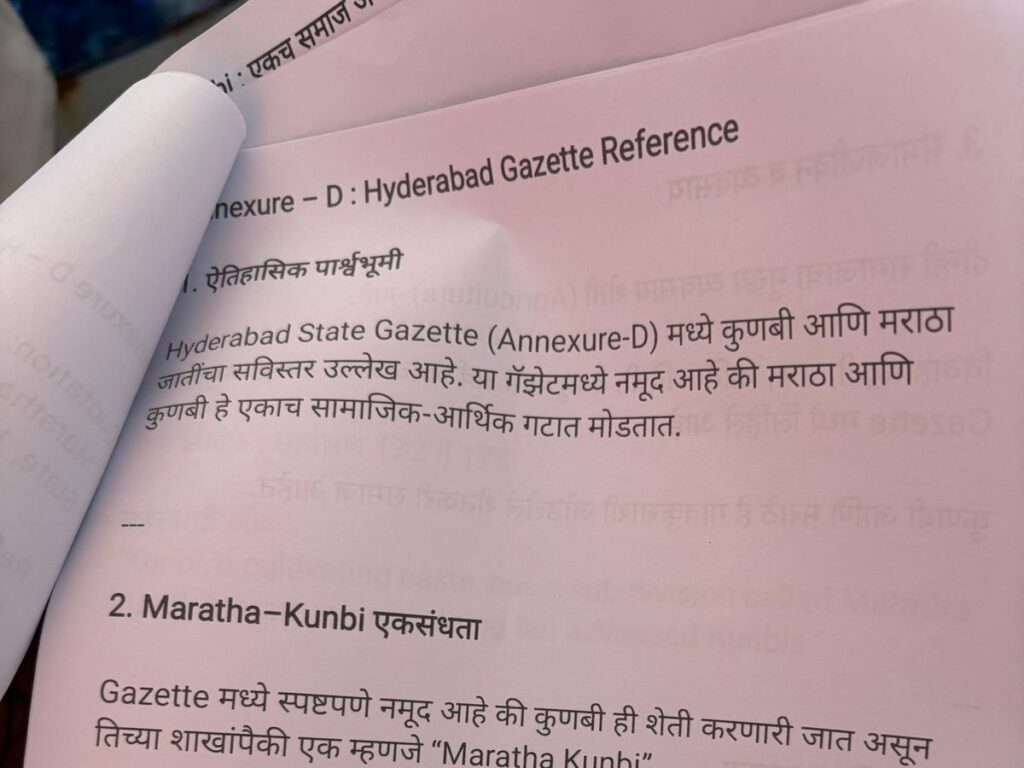
The Maratha reservation storm in Maharashtra has once again reached a boiling point, and at the centre of this controversy lies a century-old document — the Hyderabad Gazette of 1918. What was once a routine government order under the Nizam has today become the most crucial evidence in the Maratha community’s long fight for quota rights.
The Current Flashpoint
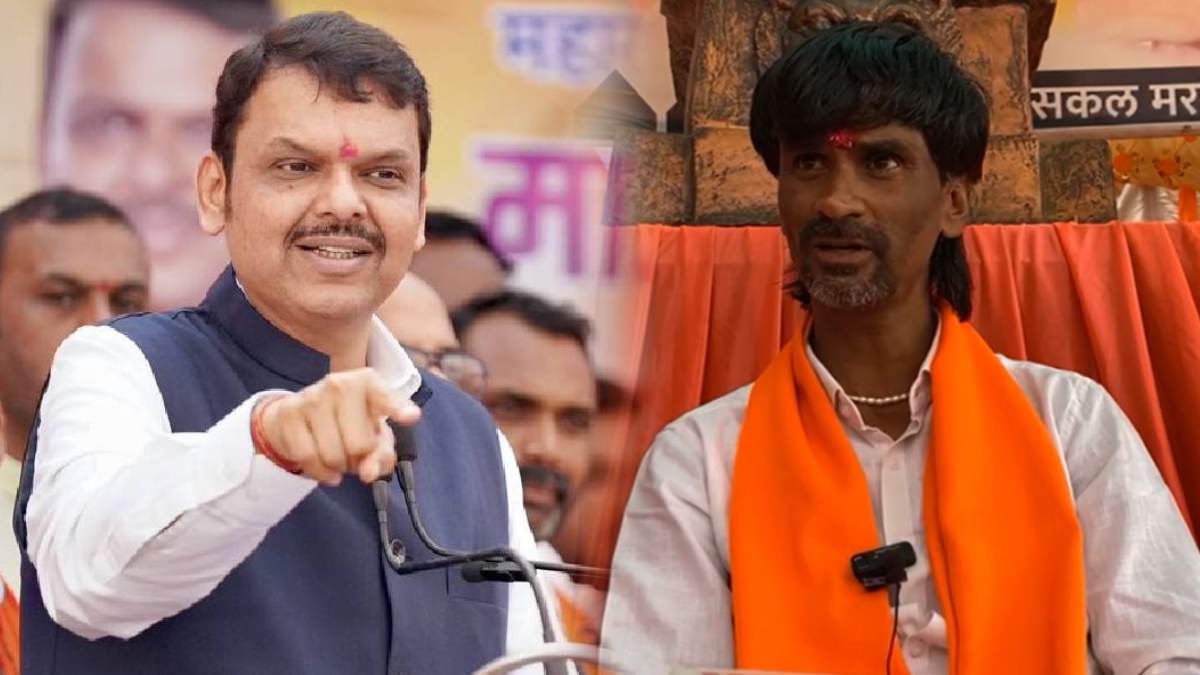
Maratha leader Manoj Jarange-Patil has intensified his protest at Mumbai’s Azad Maidan, refusing food and even water, demanding that all Marathas be granted Kunbi certificates. With this, they would automatically qualify for the Other Backward Class (OBC) category and access a 10% quota. Jarange has vowed to continue his hunger strike “till the last breath,” sparking fears of a statewide unrest.
The Maharashtra government is under immense pressure. A cabinet sub-committee led by senior ministers is in constant meetings with the Advocate General and retired judges to explore the legal standing of historical gazettes like Hyderabad and Satara. The central question: Can these documents be used to officially certify Marathas as Kunbis?
Meanwhile, OBC organisations are fiercely opposing the move. Groups such as the Sakal OBC Samaj have warned of mass protests if Maratha reservations come at the expense of existing OBC quotas. The government has promised that OBC seats will remain untouched, but tensions on the ground are escalating rapidly.
Why the Hyderabad Gazette Matters
The Hyderabad Gazette of 1918, issued under the Nizam’s administration, recognized “Hindu Marathas” as a community eligible for reservations in education and government jobs. Activists argue that this proves Marathas were historically treated at par with Kunbis.
According to the state’s own committee reports, lakhs of Maratha families have documents linking them to Kunbi lineage. In fact, over 2.39 lakh Marathas have already been issued Kunbi certificates in recent years. Protestors insist this should be expanded to cover the entire community without delay.
A Century-Old Gazette, Still Alive Today
What makes the Hyderabad Gazette extraordinary is not just its age, but its role in today’s politics. Issued in 1918 under the Nizam of Hyderabad, the document listed several communities, including Marathas, as eligible for special benefits in jobs and education. Historians say it was one of the earliest examples of affirmative action in India, long before the Constitution was written. Over a hundred years later, this faded piece of paper has become a weapon in modern legal and political battles, proving how history continues to shape the future.
The Long Struggle for Quota
- 2018: The Maharashtra government passed a law granting 16% reservation to Marathas under the SEBC (Socially and Educationally Backward Class) Act.
- 2021: The Supreme Court struck down the Act, ruling it unconstitutional as it breached the 50% cap on reservations.
- 2023–24: A revised formula provided 10% quota to Marathas and began issuing Kunbi certificates to eligible families. But protests continued, with many claiming the process was too slow and selective.
- 2025: The issue reignited with Jarange’s hunger strike, bringing the Hyderabad Gazette back to the forefront as a legal and emotional anchor.
What Lies Ahead
The government is walking a tightrope. On one side, Marathas are demanding justice based on history. On the other, OBC groups fear erosion of their own hard-earned rights. Political leaders are scrambling for a formula that keeps both sides calm without triggering another Supreme Court setback.
For now, all eyes remain fixed on Azad Maidan — where one man’s hunger strike, backed by a community’s century-old grievance, has pushed Maharashtra into yet another quota crisis.