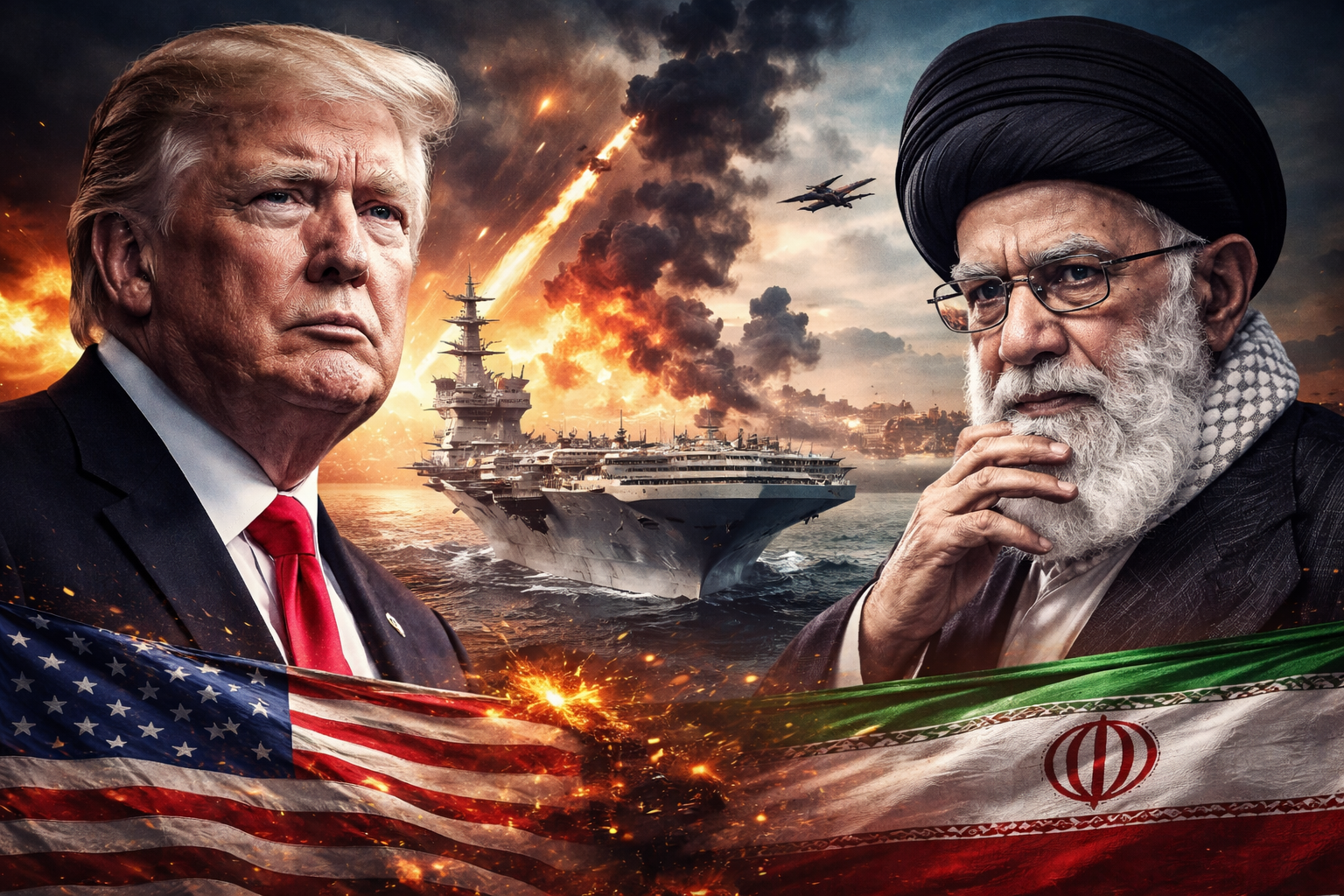
War: Tensions between the United States and Iran are once again escalating sharply, raising fears of a fresh military confrontation in West Asia. With US President Donald Trump confirming the movement of American warships toward Iran and Iran’s powerful Islamic Revolutionary Guard Corps issuing open military threats, the region appears to be sliding closer to another dangerous flashpoint.
The latest exchange of warnings has reignited speculation of a possible US Iran or Iran Israel military conflict, at a time when the Middle East is already under severe strain.
US Warships Moving Toward Iran: Trump
Speaking to the media after attending the World Economic Forum in Davos, Switzerland, President Trump disclosed that a large number of US naval vessels carrying American troops are moving toward the Gulf region, closer to Iran.
Trump said his preference was to prevent violence, not provoke it, but made it clear that Washington is closely monitoring Tehran’s actions. He warned Iran to immediately stop the killing of anti-government protesters and abandon any plans to revive its nuclear weapons programme.
According to Trump, the deployment is meant to restrain Iran rather than initiate a war. However, he underlined that the United States would not hesitate to respond if Iran resumed uranium enrichment activities.
“If Iran carries out uranium enrichment anywhere, we will go there and strike,” Trump warned, adding that any US action would be aimed at completely crippling Iran’s nuclear capabilities.
The US President also claimed that after his earlier warnings, Iran had halted the execution of around 840 protesters. He cautioned that if executions resumed, Iran would face an attack of unprecedented intensity.
US Military Deployments Confirmed
US defence officials later confirmed Trump’s statement. They said the aircraft carrier USS Abraham Lincoln, along with several guided missile destroyers, would soon reach the West Asia region.
Officials clarified that the additional deployment was aimed at strengthening air and missile defence systems in the Gulf waters. The objective, they said, was to protect existing US military bases and personnel stationed across West Asia in case Iran launched missile attacks.
The United States maintains major military bases in Bahrain, Qatar, Kuwait, Iraq and the United Arab Emirates, making the region highly sensitive during periods of heightened tension.
Iran Responds With Sharp Warning
Iran reacted strongly to the US military movement. The Islamic Revolutionary Guard Corps stated that it is closely monitoring American deployments in the Gulf.
IRGC Commander Mohammad Pakpour warned that Iran’s “finger is on the trigger” and said any attack based on miscalculation would lead to severe consequences for both the United States and Israel.
Pakpour said Iran was fully prepared for military confrontation and would respond immediately if Supreme Leader Ayatollah Ali Khamenei issued orders.
The warning was issued through an official written statement released by Iranian state media.
Any US Strike Will Face Legitimate Retaliation: Iran
Adding to the escalation, senior Iranian military official General Ali Abdollahi Aliabadi said Iran would not remain silent if attacked.
He warned that in the event of a US strike, Iran would retaliate by targeting all American military bases across West Asia. According to him, such retaliation would be legitimate and justified under international norms.
Aliabadi advised the United States to act cautiously, stating that Iran would consider any aggression as a direct act of war.

Protest Death Toll Sparks Global Concern
Amid the military tension, Iran released official figures on casualties during recent anti government protests. According to Iranian government data, 3,117 people were killed during the unrest.
The Foundation for Martyrs and Veterans claimed that 2,427 of those killed were “martyrs,” including members of security forces and civilians. The Iranian government blamed the remaining deaths on what it described as foreign inspired rioters.
Iranian President Masoud Pezeshkian said there was a clear difference between peaceful protesters and those who resorted to violence.
However, US based Human Rights Activists News Agency presented a much higher toll, claiming that 4,902 people were killed and over 26,500 people arrested during the protests.
A History of Deep Hostility
Relations between the United States and Iran have remained hostile for decades, marked by sanctions, proxy conflicts, and repeated military stand offs. Tensions peaked after the US withdrawal from the Iran nuclear deal in 2018 and the killing of IRGC General Qassem Soleimani in 2020.
Iran’s support for groups opposed to Israel and US interests has further complicated the situation, keeping the region on edge.
What Lies Ahead
With warships moving, missiles on alert, and rhetoric hardening on both sides, analysts warn that even a small miscalculation could trigger a wider regional conflict involving Israel, Gulf nations, and US allies.
For now, diplomacy appears fragile and deterrence uncertain. As both Washington and Tehran tighten their posture, West Asia once again finds itself staring at the possibility of another devastating conflict.