Hyderabad | October 2025:
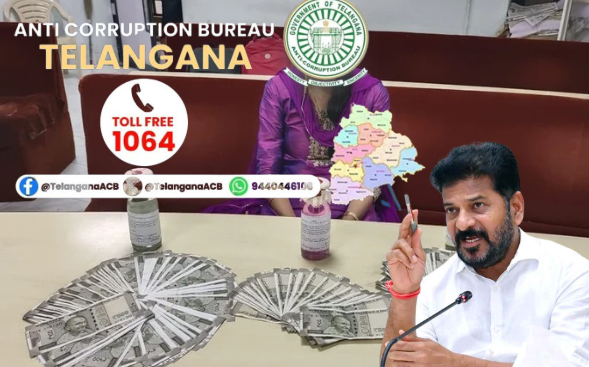
Telangana’s Anti-Corruption Bureau (ACB) has turned up the heat on graft. In just one week, the agency has carried out multiple successful trap operations across the state — from forest and fisheries offices to fire services, survey, and power departments. Officials were allegedly caught red-handed accepting bribes for routine administrative work, reaffirming that the ACB’s vigilance is at an all-time high under the Revanth Reddy government’s free-hand policy.
A Week of Relentless Raids Across Telangana
According to official ACB press bulletins issued this week, the Bureau conducted operations in Vikarabad, Warangal, Nalgonda, Rajanna-Sircilla, Nagarkurnool, and Hyderabad districts. The alleged offences include accepting bribes:
- To issue transit permits for forest produce,
- To process cooperative society membership files,
- To approve temporary firecracker licences,
- To conduct land surveys and furnish Panchanama copies, and
- To facilitate electrical connections and transformer upgrades.
Each trap was reportedly carried out following a verified complaint, after which the accused were apprehended and booked under the Prevention of Corruption Act. The seized evidence and case files have been sent for further judicial action.
Revanth Reddy’s “Free Hand” to ACB Pays Off
Chief Minister A. Revanth Reddy has made anti-corruption one of his administration’s defining agendas. By granting the ACB full autonomy and insulating it from political interference, the government has unleashed one of the most proactive anti-graft drives in recent years.
A senior government official said, “The Chief Minister has made it clear — there will be no compromise on transparency. Any official found guilty will face immediate suspension and departmental action.”
Observers say the policy shift has emboldened the agency, resulting in faster action and wider coverage — with traps now being laid in both rural and urban offices across Telangana.
Telangana’s 20-Year Anti-Corruption Track Recor
A review of two decades of ACB data shows a steady rise in both the number of trap cases and disciplinary actions. While that reflects stronger enforcement, it also reveals how deeply entrenched corruption remains across public departments.
| Period | Raids Conducted | Cases Registered | Convictions / Disciplinary Actions | Departments with Most Complaints |
|---|---|---|---|---|
| 2005–2010 | 480 | 430 | 190 | Revenue, Registration |
| 2011–2015 | 720 | 675 | 270 | Police, Transport |
| 2016–2020 | 1,050 | 980 | 360 | Panchayat Raj, Power |
| 2021–2024 | 1,200 | 1,130 | 400 | Revenue, Urban Local Bodies |
| 2025 (till Oct) | 135 | 127 | 45 (under trial) | Forest, Power, Revenue |
(Figures compiled from official ACB and RTI data available in the public domain.)

Public Reaction: Praise Mixed with Concern
The ACB’s aggressive operations have drawn widespread appreciation from the public. Citizens’ groups and social media users have lauded the Bureau’s commitment to exposing corruption, calling it a “welcome sign of accountability.”
However, the repeated occurrence of trap cases — nearly two every day, on average — has also raised questions about the depth of corruption within the system. Activists argue that punishment must be swift and visible for the deterrent effect to last.
“Raids create headlines, but quick convictions create real change,” said a Hyderabad-based transparency advocate.
Experts Call for Structural Reforms
While the ACB’s actions showcase the government’s intent, experts believe long-term change requires systemic reform.
Recommendations include:
- Digitization of file approvals and payments,
- Strict rotation of officials in high-risk posts,
- Real-time grievance tracking for citizens, and
- Enhanced internal vigilance within departments.
Such reforms, they argue, would minimize face-to-face dealings and reduce opportunities for bribery.
The Road Ahead
The Revanth Reddy government’s decision to empower the ACB has clearly revived public confidence in Telangana’s anti-corruption machinery. Yet, the steady stream of cases every week shows that the challenge remains formidable.
As the Bureau continues to act without fear or favour, citizens are watching closely to see whether these crackdowns will merely make headlines — or truly change how governance works at the grassroots.