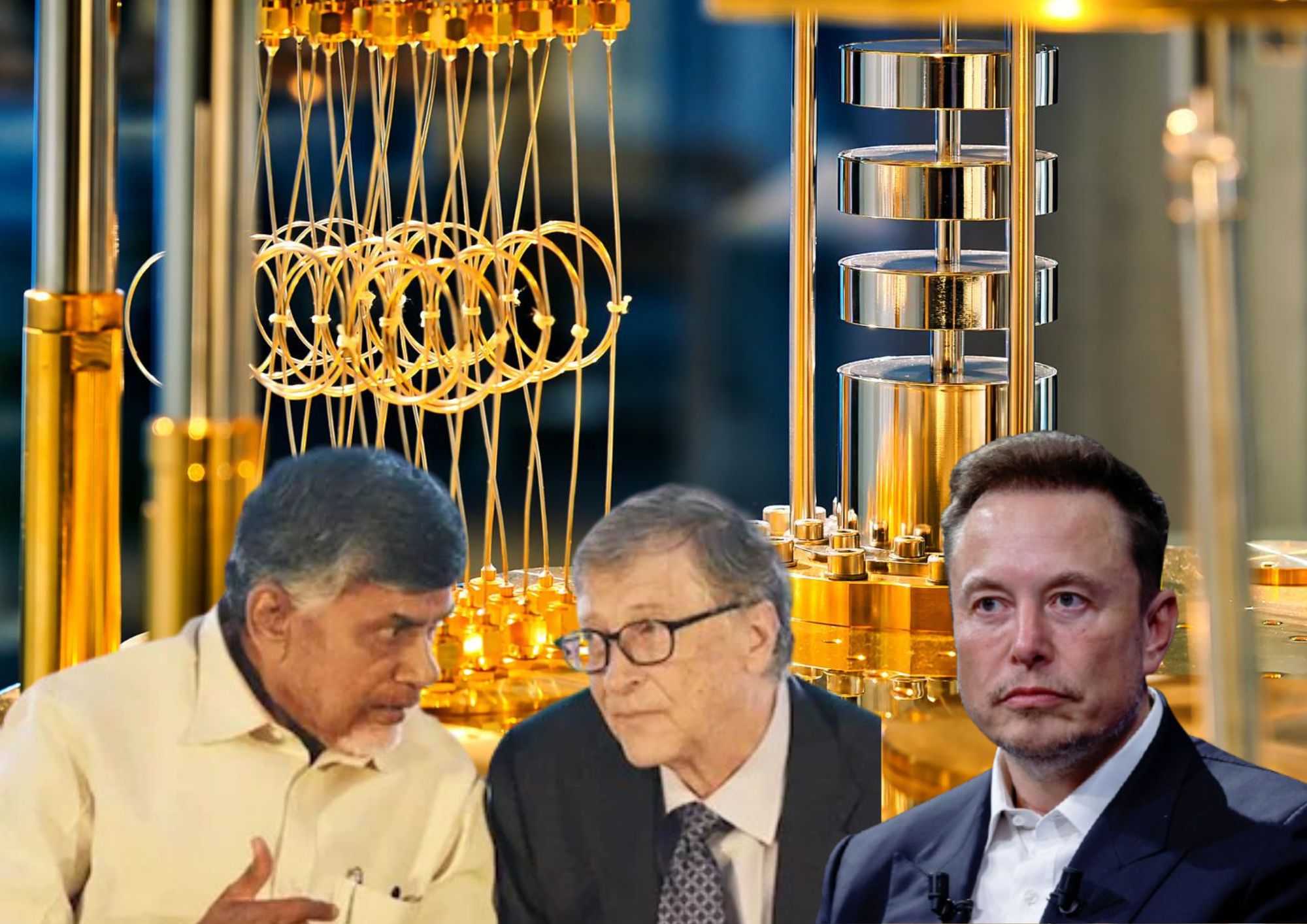
In recent months, Quantum Computing has moved from research laboratories to global political platforms. From the United States and Europe to India, world leaders are openly discussing its transformative potential. In India, Andhra Pradesh Chief Minister N. Chandrababu Naidu recently announced crores of rupees in prize money to encourage young innovators and researchers in quantum technologies — signaling how serious governments are about this emerging field.
But what exactly is Quantum Computing? Why is it suddenly so crucial? And what opportunities does it offer to students and professionals?
What Is Quantum Computing?
Traditional computers — including your smartphone and laptop — use bits (0 or 1) to process information.
Quantum computers use qubits (quantum bits). Unlike classical bits, qubits can exist in multiple states at the same time due to principles called:
- Superposition – A qubit can be 0 and 1 simultaneously.
- Entanglement – Qubits can be interconnected in such a way that the state of one affects another instantly.
This allows quantum computers to perform certain complex calculations exponentially faster than today’s most powerful supercomputers.
Companies like IBM, Google, and Microsoft are already building quantum processors, while nations are investing billions in research.

Why Is It Crucial Now?
Quantum computing has become strategically important for five key reasons:
1. National Security & Cryptography
Current encryption systems (like RSA) could be broken by large-scale quantum computers. Countries are racing to develop quantum-safe encryption before that happens.
2. Drug Discovery & Healthcare
Quantum simulations can help model molecules precisely, speeding up drug discovery and reducing costs.
3. Climate & Energy Solutions
Optimizing energy grids, improving battery technology, and solving climate modeling challenges could become easier.
4. Artificial Intelligence
Quantum-enhanced AI could solve complex optimization problems much faster.
5. Economic Leadership
Just like the AI race, the quantum race determines future technological dominance.
India has launched the National Quantum Mission (2023) with a budget of ₹6,000+ crore to develop quantum computers, communication systems, and sensors.

What Are Its Real-World Uses?
Though still in early stages, practical applications include:
- Financial risk modeling
- Traffic optimization in smart cities
- Aerospace simulations
- Cybersecurity
- Material science innovation
- Logistics & supply chain optimization
However, experts clarify that quantum computers will not replace classical computers — they will complement them for specific high-complexity tasks.
Where Can You Learn Quantum Computing?
In India:
- Indian Institute of Science (IISc Bangalore)
- Indian Institute of Technology Bombay
- Indian Institute of Technology Madras
- Indian Institute of Technology Hyderabad
Global Universities:
- Massachusetts Institute of Technology
- University of Oxford
- Stanford University
Online Platforms:
- IBM Quantum Experience (free basic access)
- Coursera (Quantum Computing Specializations)
- edX programs
- Qiskit open-source tutorials
Fees & Course Structure
- Short-term certification courses (online): ₹5,000 – ₹50,000
- M.Tech in Quantum Technologies (IITs/IISc): Approx ₹1–3 lakh per year (for Indian students)
- International Master’s Programs: ₹20–40 lakh per year depending on country
Eligibility usually requires:
- Strong mathematics background
- Physics (especially quantum mechanics)
- Programming (Python, linear algebra)
Future Scope & Job Opportunities
Quantum computing is projected to create thousands of high-skilled jobs globally by 2030.
Key Roles:
- Quantum Software Developer
- Quantum Algorithm Researcher
- Quantum Hardware Engineer
- Quantum Cryptography Specialist
- Quantum Research Scientist
Salary Range:
- India: ₹12–25 lakh per annum (entry-level research roles)
- International: $100,000+ per year in advanced roles
Major recruiters include:
- IBM
- Microsoft
- Startups like Rigetti, IonQ
- Defense and research organizations
Is It the Right Career for You?
Quantum computing is highly technical. It requires deep understanding of mathematics and physics. However, interdisciplinary roles are emerging in:
- Policy & Regulation
- Science Communication
- Quantum Project Management
- Tech Journalism
(For professionals with journalism and public policy backgrounds, covering emerging technologies like quantum could open strategic communication opportunities.)
The Bigger Picture
Quantum computing today is where Artificial Intelligence was 10–15 years ago — promising, complex, and transformative.
With governments offering incentives — including prize money announcements like those by Andhra Pradesh — India is clearly positioning itself in the global quantum race.
The coming decade may decide which nations lead the next technological revolution.
(For OG News | Special Technology Feature Report)