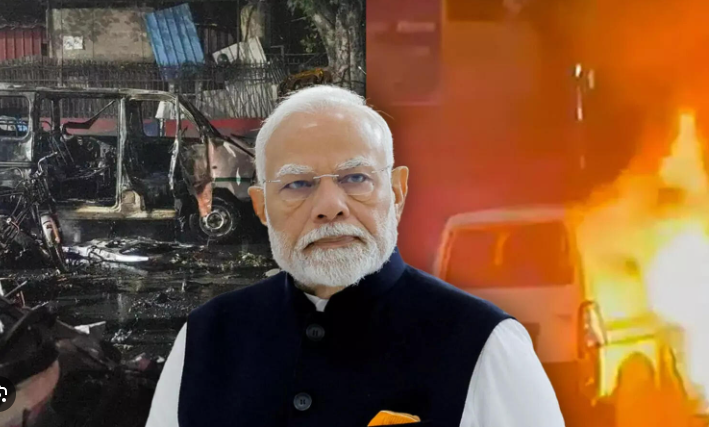
New Delhi, November 11, 2025: The devastating blast near Delhi’s Red Fort on Sunday evening has reignited India’s painful memories of past terror attacks. Initial reports confirm at least nine people killed and several others injured. The National Investigation Agency (NIA) and Delhi Police have launched a joint probe, calling it a planned terrorist act.
50 Years of Terror: A Look Back at India’s Battle Against Extremism
For nearly five decades, India has been the target of organized terrorist networks — from the Khalistani insurgency of the 1980s to cross-border terrorism in Kashmir and the urban bombings of the 2000s.
According to verified data from the Global Terrorism Database (GTD) and the South Asia Terrorism Portal (SATP), India has lost thousands of lives to terrorism-related violence between 1975 and 2023.
Year-wise fatalities (1975–2023)
| Year | Fatalities | Year | Fatalities | Year | Fatalities |
|---|---|---|---|---|---|
| 1975 | 4 | 1985 | 51 | 1995 | 361 |
| 1976 | 0 | 1986 | 340 | 1996 | 569 |
| 1977 | 0 | 1987 | 506 | 1997 | 853 |
| 1978 | 0 | 1988 | 966 | 1998 | 398 |
| 1979 | 31 | 1989 | 874 | 1999 | 469 |
| 1980 | 17 | 1990 | 907 | 2000 | 671 |
| 1981 | 24 | 1991 | 1,113 | 2001 | 660 |
| 1982 | 64 | 1992 | 1,152 | 2002 | 599 |
| 1983 | 59 | 1993 | 525 | 2003 | 472 |
| 1984 | 195 | 1994 | 389 | 2004 | 334 |
| 2005 | 466 | 2006 | 722 | 2007 | 626 |
| 2008 | 824 | 2009 | 774 | 2010 | 812 |
| 2011 | 499 | 2012 | 264 | 2013 | 467 |
| 2014 | 490 | 2015 | 387 | 2016 | 467 |
| 2017 | 465 | 2018 | 350 | 2019 | 332 |
| 2020 | 299 | 2021 | 314 | 2022 | 281 |
| 2023 | 274 | — | — | — | — |
(Sources: Global Terrorism Database & South Asia Terrorism Portal)

The data shows a clear pattern — India’s worst terrorism years were the late 1980s through the early 2000s, when annual fatalities often crossed 800 to 1,000 due to insurgencies and serial bombings.
Major Terror Strikes That Shook India
- 1980s: Punjab militancy and Khalistani terror escalate across North India.
- 1993: Serial bomb blasts in Mumbai kill over 250 people.
- 2001: Parliament attack in New Delhi; five militants neutralized.
- 2006: Mumbai local train bombings kill 180+ commuters.
- 2008: 26/11 Mumbai terror attacks leave 166 dead.
- 2019: Pulwama suicide bombing claims 40 CRPF soldiers.
Each of these incidents marked a grim chapter in India’s counterterrorism history.
A Decade of Stability: India’s Counter-Terror Evolution
In the last decade, India has drastically reduced the frequency and impact of terror attacks. Annual fatalities have dropped from thousands in earlier decades to a few hundred in recent years. Experts attribute this to:
- National Investigation Agency (NIA): Strengthened nationwide coordination in terror probes.
- Technological Policing: Deployment of AI-driven surveillance, CCTVs, and digital intelligence tracking.
- Armed Forces Efficiency: Continuous counter-insurgency operations in border and sensitive regions.
- Financial Crackdowns: Freezing of terror funding and dismantling of sleeper networks.
- Global Partnerships: Intelligence-sharing and joint operations with partner countries.
While isolated attacks like the Delhi Blast 2025 serve as reminders that the threat persists, India’s overall security framework has matured to prevent large-scale coordinated strikes like those seen in the past.
The Delhi Blast: A Wake-Up Call
According to early NIA inputs, the explosive used near Red Fort appears to be a high-grade, remote-triggered device. Investigators are tracing possible links to sleeper cells and online radical networks.
The government has deployed additional forces at sensitive installations across Delhi and major metros.
A senior security officer told this publication, “India’s counterterror mechanisms are strong, but one lapse is enough to cause devastation. Continuous vigilance is our only shield.”
Conclusion: From Turbulence to Tenacity
From the turbulent 1980s to today’s era of technological intelligence, India’s journey against terrorism reflects its resilience. The Delhi blast, though tragic, serves as a reminder that peace is preserved not by silence, but by constant vigilance.